Why Public Libraries Are More Than Places to Borrow Books
Why public libraries are more than places to borrow books: follow a clear weekly routine to spot how access, learning and shared space support civic life.
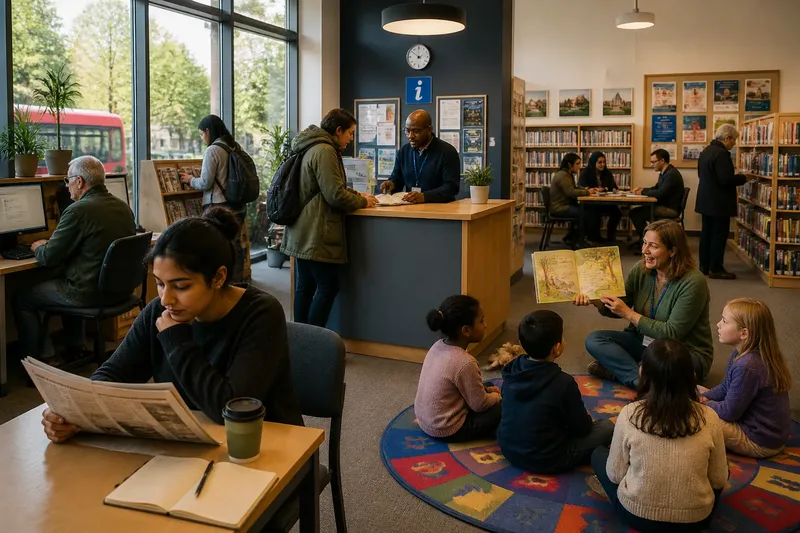
Why are public libraries more than places to borrow books? Follow what happens across an ordinary week: one visitor reads at a quiet table, another asks where to find a council form, and a parent brings a child to a story session. Each visit serves a different purpose, yet the library gives them a shared place to begin.
Use the routine below to notice how the branch works, rather than judging it by one visit or one service. You can make each observation during a brief visit; you do not need to attend every event or join a committee.
Start the week by checking practical access
On Monday, look at how a visitor gets in and finds their way around. Check the approach from the pavement or bus stop, the entrance, signs, opening information and location of the help desk. If the route or signage is unclear, note where the difficulty begins and ask staff how visitors can raise an access concern.
Notice what is open to everyone and what requires registration. Reading a newspaper or sitting at a public table may not require a library card, while borrowing materials usually has its own arrangements. If a particular service requires membership, check the branch’s current rules before relying on it; if you only need a place to read, ask whether that use is open to visitors.
On Tuesday, see which resources people share
Look for resources that visitors can use without owning them: books, large-print materials, newspapers, computers, printers, local information or study space. The mix differs by branch, so compare what is available with the needs it might serve rather than expecting every library to offer the same facilities.
Shared access can make information and space easier to reach. A visitor might consult material without buying it, use a desk without having a suitable room at home, or ask where to find a public service. These options do not remove barriers such as travel, opening hours, language, disability or limited digital access. If a resource is present but difficult to use, note the obstacle as well as the resource.
On Wednesday, watch how informal learning happens
Learning does not always take the form of a class. A visitor may compare information for a personal decision, practise a language, help a child with homework or learn to use a computer. Staff might explain how to search a catalogue, point to a resource or direct someone to an appropriate service.
Notice whether visitors can learn at their own pace: reading quietly, asking a question, joining a session or returning to a topic later. If the help offered is about using library resources, staff can explain those resources; for legal, medical or financial decisions, a qualified professional or responsible public service is the right source of advice.
On Thursday, notice how different visitors share the space
Look for ways people gather without needing the same purpose. A children’s activity, a local group meeting or a conversation near the entrance can bring people into the same building. Other visitors may prefer to sit alone among other people. Both uses can belong in a public setting.
Check how the branch manages noise, room bookings and different activities. If a group has a reserved room, see whether other visitors can still find space for quiet study or another use. If an activity disrupts access to a shared area, describe the specific conflict rather than assuming that one use matters more than another.
Say a new resident, in an invented situation, visits the local library on Thursday to use a public computer and find local service information. They ask a staff member where to look, then see a notice for a language conversation group. They leave with the information they needed and the option of attending later; the observable result is a clearer route to local resources, without requiring the library to provide every service itself.
On Friday, follow the route for information and feedback
Check how the branch explains its offer and receives comments. Look at a printed events sheet, council webpage or noticeboard, or ask staff where service decisions are made. If the information is clear, you can use it to plan a visit; if it is missing or hard to understand, note what you could not find and ask which council team handles feedback.
If you raise a concern, separate what you observed from the change you want. For example, identify a sign that is difficult to read, then ask whether clearer directions can be considered. A specific description gives staff or the responsible council service something concrete to assess.
Use these checks to judge the library’s civic role?
Can I use a library without borrowing anything?
Many branches allow visitors to read, study, attend an event or ask about resources without borrowing. If you need a particular facility or an accessible entrance, check the branch’s arrangements before travelling.
How can a library help someone find public information?
Staff may help locate a catalogue, directory, computer or public-service contact. They can point to information, but the responsible agency or a qualified adviser remains the source for decisions that need professional judgement.
What makes a library a shared civic space?
It brings people with different purposes into a place supported as a public service. Practical access, clear expectations and room for varied uses matter more than visitors sharing the same views.
What should I do if a service is missing or hard to use?
Tell library staff or the council service responsible for the branch what you encountered and where. If you can, describe the obstacle and the change you are seeking, so the relevant decision-maker can understand the issue.
Keep the observations specific and proportionate
- Monday, entrance: Check whether the route from the pavement or bus stop and the entrance are usable for your visit. If you find an obstacle, note its location and ask staff where to report it; if access is straightforward, move on to the interior signs.
- Monday, signs: Check whether you can locate the help desk, quiet area and opening information. If a sign is unclear, record what it fails to identify and ask whether it can be reviewed; if directions are clear, use them to see how a first-time visitor might proceed.
- Tuesday, resources: Check which materials, computers or study spaces visitors can use. If a needed resource is present but hard to access, ask about the access arrangements; if it is not available, ask whether another local service offers it.
- Wednesday, learning: Check whether visitors can get help using the catalogue or finding library materials. If they need advice beyond that remit, ask staff for a referral route; if their question concerns library resources, use the staff guidance or catalogue.
- Thursday, shared space: Check whether quiet use and group activities can coexist. If a booking or activity blocks another use, describe the conflict to staff; if the spaces work for both, note the arrangements that make this possible.
- Friday, feedback: Check whether the branch or council explains how to comment on its service. If you cannot find a route, ask staff or the council; if the route is clear, use it to send a specific observation rather than a general verdict.
What is not worth the effort is judging a library by counting books alone. Collections matter, but they do not show whether people can reach the building, use its spaces, ask for help or take part in learning. Nor does one busy event establish how well the service works for everyone.
Instead, consider how the functions connect. Shared materials can support individual learning; a welcoming room can help someone find local information; a group activity can introduce a visitor to a place they later use independently. A week of focused observations makes the civic role of public libraries more visible, while keeping their limits in view. If you want to contribute, take your clearest observation to staff and ask where the relevant service decisions are made.